- Mon - Sat : 8 A.M to 7 P.M / Sunday : 10 A.M to 4 P.M
- Nationwide


Care home residents, particularly older adults, are among those most vulnerable to falls and the serious injuries that can result. Falls remain one of the leading causes of hospital admission in the UK. The consequences of a fall, including fractures, lasting loss of confidence and increased dependence on equipment, can be life-changing. Our specialist physiotherapists design and deliver evidence-based falls and fracture prevention programmes to reduce each individual’s risk, rebuild strength, stability and balance, and support them to move with greater safety and confidence.
Care home residents, particularly older adults, are among those most vulnerable to falls and the serious injuries that can result. Falls remain one of the leading causes of hospital admission in the UK. The consequences of a fall, including fractures, lasting loss of confidence and increased dependence on equipment, can be life-changing. Our specialist physiotherapists design and deliver evidence-based falls and fracture prevention programmes to reduce each individual’s risk, rebuild strength, stability and balance, and support them to move with greater safety and confidence.

Falls are not an inevitable part of ageing. Many are preventable if the risks are identified and addressed in a timely manner. A fall can have a devastating impact on an elderly individual’s confidence, wellbeing and overall quality of life. Furthermore, the consequences of resulting injuries, such as a hip fracture, can be life-changing.
Our physiotherapists have the in-depth experience to carry out thorough assessments, identifying risk and implementing personalised falls prevention plans. We work closely with care home team members to support safe movement every day, taking a holistic approach that looks at the individual as a whole, with safety at the heart of everything we do.
Reduced muscle strength can make everyday movements more difficult, reduce stability, and affect the ability to react quickly or regain control after a trip, increasing the risk of falling.
Factors like reduced joint range of movement and muscle weakness result in difficulty maintaining balance in standing or walking, or holding on to furniture to stabilise, increasing the risk of falling.
Reduced muscle strength changes the mobility pattern and pace, such as shuffling, with everyday activities becoming effortful.
Stiffness in the joints and muscles causes pain on movement, reducing the frequency of walking and altering the walking pattern, increasing the risk of falls.
Fatigue due to low activity levels results in developing instability in activities such as walking to the toilet, increasing the risk of falls at the end of the day.
Urinary urgency, especially at night, can lead to rushing which significantly increases the risk of a fall, as an older person is tired and feeling anxious.
Changes in vision and hearing can reduce an older adult's awareness of their surroundings and hazards, increasing the risk of falls.
Having multiple or combinations of medications can cause dizziness or drowsiness, increasing the risk of falling.
Confusion and poor short-term memory can affect an older person's insight into their own physical limitations and ability to move around safely.
Not having an appropriate amount of fluids can cause light-headedness, confusion, risk of infections and weakness, thus causing falls.
Inactivity or sitting for long spells has a detrimental effect on muscle strength, endurance and safe movement, increasing the risk of falls.
Long term conditions such as stroke or Parkinson's affect movement, coordination and balance, increasing the risk of falls if not actively treated.
Fear of falling often leads to loss of confidence in moving around and reduced activity. This causes physical deconditioning, creating a cycle of recurrent falls.
Shoes or slippers that lack adequate support increase the risk of slipping, tripping or losing balance during everyday movement.
Long term conditions such as stroke or Parkinson's affect movement, coordination and balance, increasing the risk of falls if not actively treated.
Reduced muscle strength can make everyday movements more difficult, reduce stability, and affect the ability to react quickly or regain control after a trip, increasing the risk of falling.
Factors like reduced joint range of movement and muscle weakness result in difficulty maintaining balance in standing or walking, or holding on to furniture to stabilise, increasing the risk of falling.
Reduced muscle strength changes the mobility pattern and pace, such as shuffling, with everyday activities becoming effortful.
Stiffness in the joints and muscles causes pain on movement, reducing the frequency of walking and altering the walking pattern, increasing the risk of falls.
Fatigue due to low activity levels results in developing instability in activities such as walking to the toilet, increasing the risk of falls at the end of the day.
Urinary urgency, especially at night, can lead to rushing which significantly increases the risk of a fall, as an older person is tired and feeling anxious.
Changes in vision and hearing can reduce an older adult's awareness of their surroundings and hazards, increasing the risk of falls.
Having multiple or combinations of medications can cause dizziness or drowsiness, increasing the risk of falling.
Confusion and poor short-term memory can affect an older person's insight into their own physical limitations and ability to move around safely.
Not having an appropriate amount of fluids can cause light-headedness, confusion, risk of infections and weakness, thus causing falls.
Inactivity or sitting for long spells has a detrimental effect on muscle strength, endurance and safe movement, increasing the risk of falls.
Long term conditions such as stroke or Parkinson's affect movement, coordination and balance, increasing the risk of falls if not actively treated.
Fear of falling often leads to loss of confidence in moving around and reduced activity. This causes physical deconditioning, creating a cycle of recurrent falls.
Shoes or slippers that lack adequate support increase the risk of slipping, tripping or losing balance during everyday movement.
Long term conditions such as stroke or Parkinson's affect movement, coordination and balance, increasing the risk of falls if not actively treated.
Our experienced physiotherapists assess holistically, taking both extrinsic and intrinsic factors contributing to falls. Using an evidence-based approach, they are able to identify your current abilities, risks and areas that need attention.
We thoroughly evaluate balance, strength, walking pattern, transfers, mobility, previous falls and the safe use of mobility aids. We also consider factors such as pain, medical conditions, medications and hazards which may be increasing the risk of falls or contributing to them.
We use validated outcome measures like Tinetti and the Falls Efficacy Scale alongside our clinical expertise, to provide an objective and reliable assessment. These tools are standardised nationally and are good predictors of falls probability
We evaluate the suitability of all aids and equipment currently in use, including walking aids, transfer aids and equipment such as bed rails. We assess whether each aid is appropriate, correctly sized and being used safely. We also consider whether there is potential to progress, for example from a hoist to a Sara Steady, supporting greater independence.
Following the assessment, we work closely with the care home staff to share our findings and ensure safety recommendations are embedded for residents. We remain in regular contact with the team to review progress and update the plan as the individual's needs change.
Following the detailed assessment, an individualised plan is developed which includes exercises, mobility training and progression with or without aids, balance retraining and practical advice to reduce falls risk and support safe, independent movement.
Effective falls prevention is a dual process, encompassing both prevention and rehabilitation to support an older adult back to their previous level of mobility and function. Early identification and timely action to address risk factors can significantly reduce the likelihood of a fall. Additionally, prompt rehabilitation following a fall helps older individuals regain strength, balance and mobility, reducing the risk of recurrent falls and preventing long-term functional decline. Together, these two approaches improve outcomes, maintain quality of life and support people to remain active and independent for longer.
We review the resident's medical history, falls history, care plan and any existing risk assessments to establish a baseline before our first visit.
Our physiotherapist carries out a comprehensive assessment using validated tools, clinical observation and a detailed review of the individual's movement and abilities.
A tailored programme is designed for each individual, combining a home exercise plan with the use of appropriate mobility and transfer aids and techniques.
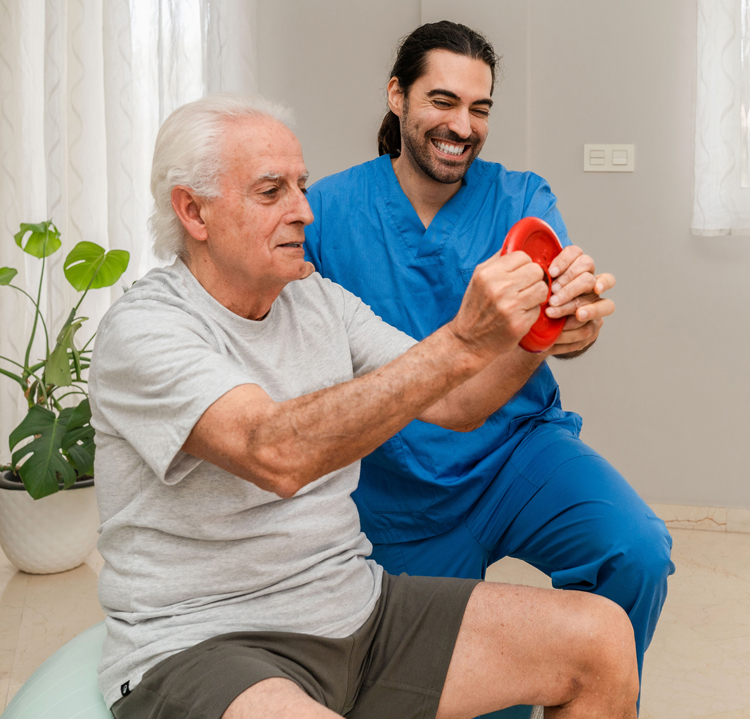
Our physiotherapist delivers balance training, strength building, mobility training and progression, as well as manual therapy to reduce pain and stiffness. Written exercise programmes are provided for the care team to support practice between visits where possible.
We liaise with the care home staff, updating them on safe transfer techniques using appropriate equipment, falls risk awareness and strategies to encourage physical activity for each individual.
We reassess regularly, adjusting the plan based on individual progress and maintaining open communication with families and the care home team.
A fall can lead to a rapid loss of confidence, reduced activity and physical deconditioning, creating a spiral of recurrent falls if not addressed. Starting rehabilitation at the right time helps regain lost abilities and minimise the effects, preventing falls in the first place. This helps an older adult avoid the process of undergoing intensive rehabilitation altogether and maintain independence. Our physiotherapists work directly with elderly individuals, to reduce the risk of first fall or support recovery after one, building strength, balance and confidence through a personalised plan. This is done by delivering one to one hands-on rehabilitation and falls prevention programmes, and providing training and support to the care home staff for safe systems.
Balance retraining is an inherent part of falls prevention and recovery. An individualised rehabilitation programme is put in place to address the factors contributing to impaired balance. By targeting both static and dynamic balance, which are essential for maintaining stability in sitting and standing positions, exercises such as weight shifting, reaching tasks, and controlled movement activities help improve postural control, build confidence, and reduce the risk of falls during everyday activities.
A structured exercise plan tailored to individual ability, consisting of bed, chair, and standing exercises. These focus on core stability, lower limb strength, and postural control for individuals with limited standing tolerance or higher dependency needs. Progressive standing exercises include weight shifting, stepping practice, and reaching tasks, designed to challenge and improve balance reactions and help prevent falls
We identify difficulties with walking and mobility and provide an individualised rehabilitation plan to address them. This includes practising safe walking patterns, maintaining an appropriate pace, and using walking aids correctly. By building confidence and promoting efficient movement, we help individuals move more safely and independently around the care home.
We assess the suitability of each individual's mobility aids, including walking sticks, frames, and outdoor walkers, ensuring the correct height, ferrules, and overall fit for safe use. We also provide recommendations on the most appropriate mobility aid for the individual following assessment, and communicate updates to the care team so these can be incorporated into the care plan. The physiotherapist supports individuals to practice using their aids correctly and confidently, with gradual increases in distance and frequency. We also consider other equipment that supports daily living, ensuring everything in place is appropriate, safe, and used to its full benefit.
This involves practising everyday movements such as sit-to-stand from a chair, transfers on and off a toilet or commode, and getting in and out of bed, to rebuild the skills needed for daily independence. These activities improve strength, coordination, and confidence in completing daily tasks.
Hands-on treatment to reduce pain and stiffness in joints and muscles, helping to restore normal movement patterns and decrease pain on walking.
Graded activity and safe progression are used to rebuild confidence in movement and help break the cycle of fear of falling and physical deconditioning in individuals at risk of falls or after a fall.
Hands-on treatment to reduce pain and stiffness in joints and muscles, helping to restore normal movement patterns and decrease pain on walking.
We provide training for care home staff in safe transfer techniques for residents using aids such as hoists, Sara Stedy, stand aids, and Molift equipment. We can also assess the suitability of equipment and whether it is safe for use with a particular resident. The physiotherapist is also able to advise whether equipment is in working condition or needs to be replaced. This promotes safety, reduces the risk of injury to both residents and staff, and ensures consistency of care.
Care teams spend the most time with residents and are often the first to notice changes in physical ability and movement. Even small issues, such as worn ferrules, can increase the risk of instability and falls and should be identified and escalated promptly to help prevent falls. Care teams therefore require training to recognise such issues effectively. Staff education sessions equip them with the knowledge to identify signs of increased falls risk, recognise residents who may need closer monitoring, and know when to escalate concerns. Our team is skilled in providing training on identifying falls risk in everyday life thus, promoting prevention.
We deliver structured group exercise sessions led by experienced physiotherapists and supported by rehabilitation assistants, focusing on upper and lower limb strength, core stability, and flexibility. Staff involvement is encouraged, helping to promote social engagement, increase participation, and support consistency of activity across the care home.
We support care homes with clear, structured processes for the safe management of residents following a fall. This includes floor-level safety protocols, clear escalation pathways for clinical review, and robust documentation to support incident reporting and ongoing risk assessment. Our approach helps care teams respond confidently and consistently, supporting good practice and strengthening care planning following an incident.
We aim to carry out an initial assessment within 24–48 hours of referral. A personalised programme can typically begin at the same visit or within the following session.
Yes. Our team is trained to work with elderly individuals living with dementia or cognitive impairment, adapting the plan accordingly.
Visit frequency depends on the individual's needs and the level of support required. We typically recommend weekly or fortnightly visits for active rehabilitation, which can also be supplemented by visits from our rehabilitation assistants.
Absolutely. As well as working with individual residents, we can provide a structured environmental audit of the care home and advise on improvements to reduce falls across the whole home.
Yes. Our services are available for all residents living in the care home, whether on a permanent or respite basis.
Fill in our enquiry form
Speak to our team about how physiotherapy can support the residents in your care.